
Squirrel Hill Addition: Building Up from the Ground Down

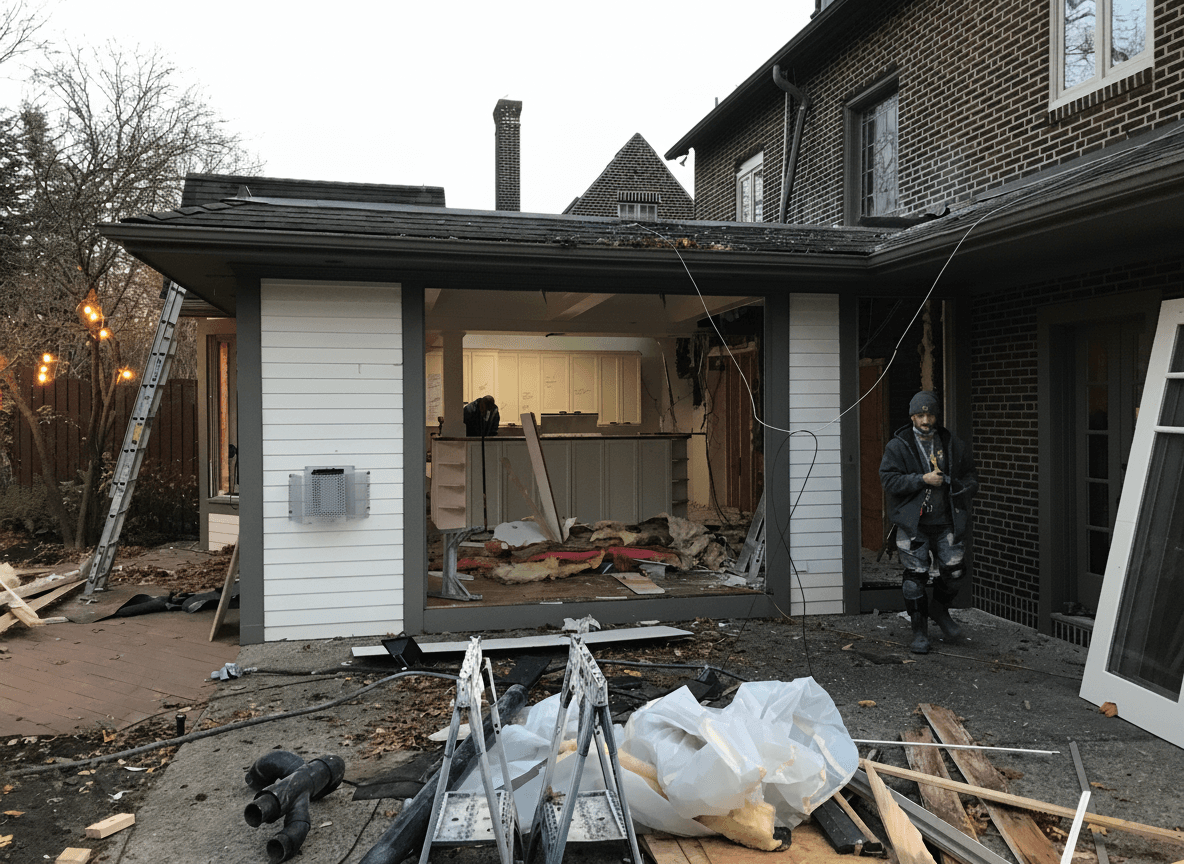
The house at 1319 Squirrel Hill Ave had carried its history quietly. An original 1800s brick home, it wore its age in the shallow unconditioned crawlspace beneath a small single-story addition and a kitchen that had long since run out of room. When the owners came to B2 Construction in fall 2020, the ask was straightforward in concept and demanding in execution: build a four-story addition that would connect to the existing structure, expand the home's footprint meaningfully, and do it right — from the ground up.
Work began in November 2020. What followed was nearly a full year of deliberate, methodical construction across some of the most challenging winter conditions Pittsburgh can deliver.
---
Excavation in Winter

By December 10, 2020, the site had been opened up. The excavation measured 32 feet by 36 feet at a depth of 12 feet — a significant dig by any measure, especially in residential construction. Gravel and stone aggregate stockpiles flanked the site, and the exposed soil layers told the story of what the crew was working with. Temporary metal scaffolding was already in place along the existing brick facade, and boarded window openings on the original structure protected the home during what would be a long winter build.
The depth of that excavation wasn't arbitrary. A proper basement foundation demands that you go deep enough to get below the frost line and create a structurally sound platform for everything above it. There are no shortcuts at this stage — only decisions that you'll live with for decades.
---
Forming the Foundation Through the Cold

January in Pittsburgh is not a kind month to pour concrete. By January 6, 2021, the site was wrapped in temporary weather protection — sheeting and enclosures designed to hold enough heat for concrete to cure properly. Concrete foundation wall forms were set, and pallets of concrete mix were staged and ready. The scaffolding system had grown alongside the work, supporting both access and the protection systems needed to fight off the cold.
Pouring concrete in freezing temperatures requires careful management of mix temperature, curing conditions, and timing. Skipping any part of that process introduces weaknesses that don't show up immediately — but will. B2's approach here was to slow down and protect the work rather than push through and compromise it.
---
Tying the Old to the New

By late January, the foundation walls were insulated and the base was compacted and laid out for structural framing. What the January 25 photos reveal just as clearly is what was happening to the existing structure: the brick facade of the original 1800s home had been carefully removed and staged, prepared to receive the new addition at the tie-in point. This is one of the more delicate phases of any addition project — disconnecting the old building from what it's been doing for over a century and preparing it to bond with something new.
The insulation board visible on the foundation walls at this stage reflects a commitment to building a conditioned, thermally efficient basement — a significant improvement over the shallow unconditioned crawlspace the home had relied on before.
---
Radiant Heat from the Slab Up
 Creatherm dimple method. thermal insulation board with integral thermal breaks, concrete subfloor preparation, in-situ installation in progress, 1/2' rebar grid suspended on 2' concrete chairs" loading="lazy" width="800" height="450" decoding="async" style="aspect-ratio:16/9;object-fit:cover;">
On February 3, 2021, the floor system took shape in a way that most finished rooms never reveal. PEX tubing was installed in a full grid using the Creatherm dimple method — a system in which the tubing locks into a thermal insulation board with integral thermal breaks, keeping heat directed upward into the living space rather than down into the slab. A 1/2-inch rebar grid suspended on 2-inch concrete chairs provided the structural reinforcement before the concrete subfloor was poured over the assembly.
The materials here reflect careful sourcing: Creatherm panels for the radiant system, Rehau PEX tubing, Stego Wrap vapor barriers, and Dayton Superior products supporting the concrete work. Owens Corning Foamular insulation board was used on the foundation walls. These aren't decorative choices — they're the infrastructure that determines how the building performs year after year.
---
What the Work Becomes

By the time the addition was complete in October 2021, the months of excavation, forming, insulation, and careful framing had become something entirely different in character. The finished interior — captured in a later photo from July 2022 — shows hardwood flooring from Allegheny Mountain Hardwoods, double-hung black aluminum windows, a fireplace with a dark tile surround, and wrought iron stair railing climbing toward the upper floors. A spherical brass chandelier anchors the room above a grand piano. The Montigo fireplace grounds one wall while the windows flood the space with natural light.
None of that happens without the 12-foot excavation in December, the cold-weather concrete pours in January, or the radiant tubing laid methodically across a frozen jobsite in February. The finish is what people see. The foundation is what makes it last.
---
The Squirrel Hill Addition took eleven months of consistent, skilled work — through winter conditions, complex tie-ins to a 19th-century structure, and a multilayered assembly of systems that had to work together before a single finish material was ever installed. That's the nature of doing this kind of project correctly.