
Before You Add an Elevator: What the Exterior of Your Home Will Go Through First
Most homeowners picture a residential elevator as an interior project. A shaft appears, doors open into a corridor, and life becomes easier between floors. What that picture leaves out is everything that happens outside the house first — and it is considerable. The Upper St. Clair residential elevator project is a useful case study in what that exterior disruption actually looks like, phase by phase, before a single interior wall is touched.

This rear corner of the home was selected deliberately. Positioning the elevator shaft at this junction places the door openings in the least invasive locations across all three interior stops — basement, first floor, and second floor. That kind of decision sounds simple. It is not. It requires reading the home's structural logic, its traffic flow, and its mechanical systems simultaneously, then committing to a corner of the building that will be fundamentally rebuilt from the ground up. The photograph from October 2024 shows a quiet, intact exterior. It would not stay that way for long.
---
The Scope Is Larger Than It Looks

By April 2025, the full scope of work was defined: excavate a new basement addition, pour an elevator-specification foundation, construct exterior walls from that foundation to the roofline, then build a new roof section and tie it seamlessly into the existing structure. The finished elevation must match the existing home exactly. The new shaft must meet or exceed the elevator manufacturer's strict structural requirements. These two constraints — aesthetic continuity and engineering precision — run in parallel throughout every phase of the project and neither one gives ground to the other.
---
Demolition Is a Craft, Not a Wrecking Operation

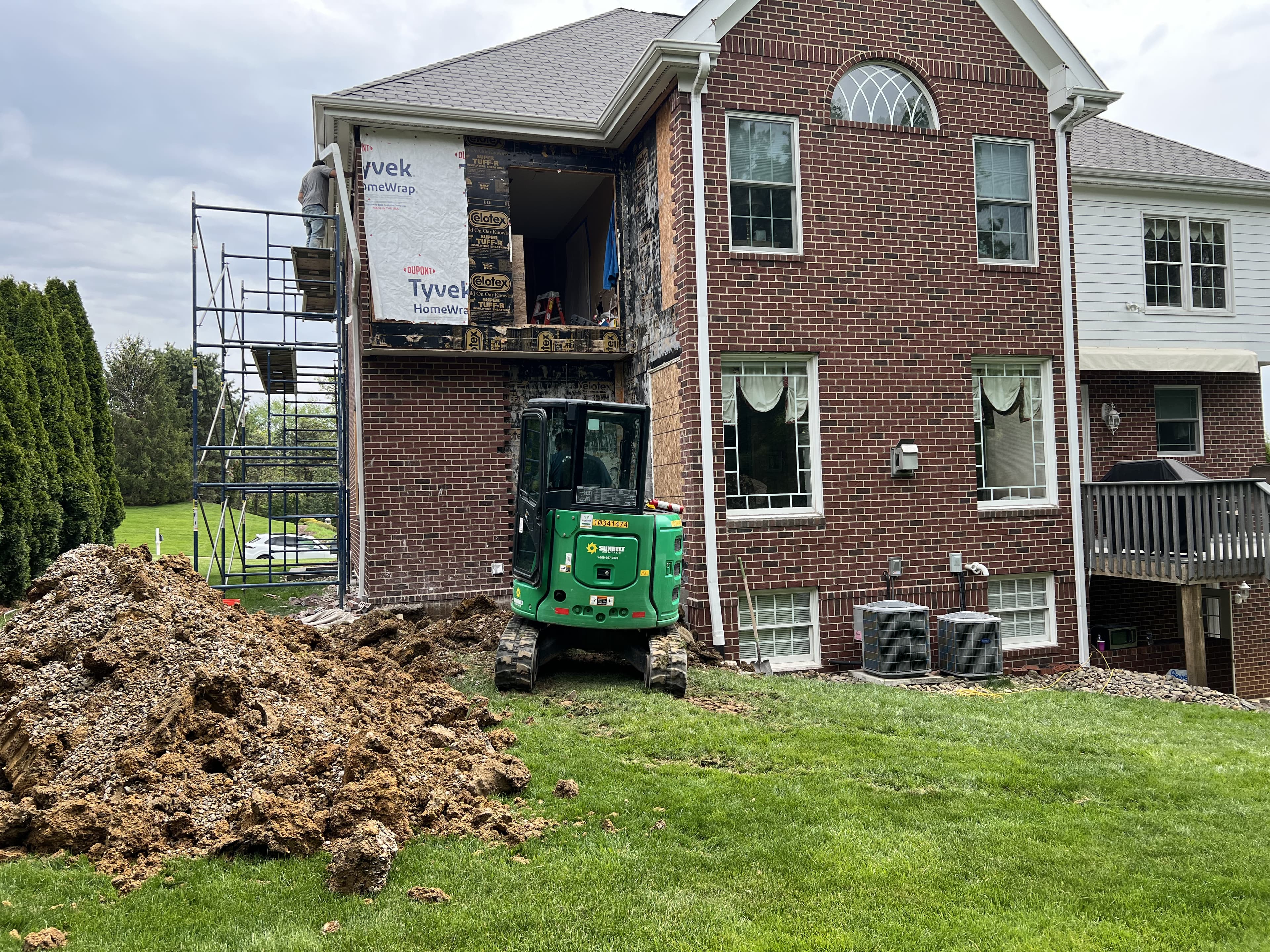
Exterior selective demolition began in early May. Removal included windows, brick facade, exterior cladding, and roof trim materials. An air conditioning unit required relocation before work could proceed. Scaffolding was erected along the side of the building to allow installation of a new window — a detail worth noting, because this is where preparation and sequencing reveal actual competence. Scaffolding does not go up randomly. It goes up in service of a specific sequence, and that sequence determines whether adjacent finishes survive the process.
The excavation had also begun by this point. Excess earth was staged on site, held for backfilling and eventual hauling. The yard was in active use as a staging area, the facade was partially open, and the project had moved from planning into the kind of organized disruption that requires constant coordination to keep from becoming chaos.
---
Breaking Into the Basement

Once excavation reached the required depth, the crew broke through the existing basement wall. This photograph from May 8th shows the opening being created — and it is important to understand what that work demands. This is a load-bearing wall. Strategic care and field experience are not optional here; they are the margin between a controlled opening and a structural problem. The debris removal alone is significant labor, and with ladder access as the only means in and out of the pit, every bag of concrete, every broken block, every shovel of earth travels the same route.
There is no shortcut in a confined excavation. The work is exactly as slow and physical as it looks.
---
Foundation Formwork and the Ground Water Reality

Foundation formwork and rebar installation began on May 13th inside a 10-foot by 10-foot excavation cavity. The wooden framing establishes the perimeter. The structural reinforcement grid is laid across it. And at the center of the photograph, a makeshift sump basin and pump runs continuously — because in the Pittsburgh area, ground water will be present at this depth. That is not a surprise. It is an expectation, and it is planned for accordingly.
The elevator manufacturer's foundation requirements are specific and non-negotiable. The rebar layout, the footing dimensions, the concrete thickness — all of it answers to a specification that exists for good reason. An elevator shaft that settles or shifts is not a cosmetic problem.

The second photograph from the same date shows wooden bracing and cross-bracing installed across the rebar grid, holding the formwork rigid in advance of the concrete pour. The red sump bucket remains in position. Rather than a conventional perimeter footing, this project called for a full 12-inch-thick monolithic footing slab — a single continuous pour across the entire foundation cavity. That decision reflects the structural demands of the shaft above it and the ground conditions below it. It is the kind of choice that does not appear in any finished photograph but carries the weight of everything that comes after.
---
What Homeowners Should Expect
If you are considering a residential elevator addition, here is what this project illustrates plainly:
- Your exterior will be partially deconstructed. Brick, cladding, windows, and trim in the affected area will come off before anything new goes on.
- Your yard becomes a worksite. Excavated earth, scaffolding, equipment, and debris staging all require ground-level space and active management.
- Foundation work is the slowest phase per square foot. Confined excavation, ground water management, formwork, rebar, and a precision concrete pour cannot be compressed beyond their natural timeline.
- Matching the existing structure is a non-trivial requirement. Elevation, materials, and finish must reconcile with a building that was not designed to accommodate this addition.
The Upper St. Clair project is ongoing, and the exterior phase shown here is the foundation — literally — for everything that follows. The shaft walls, the roof tie-in, the window installation, the interior rough-in, and the elevator system itself all build on what was established in that excavation pit.
---
View the complete Upper St Clair Residential Elevator project