
LED Lighting in Historic Spaces: How Recessed Lighting Was Added Without Compromising a Victorian Parlor
There is a particular kind of pressure that comes with cutting into a ceiling that has been intact for over a century. The Shadyside Parlor Restoration project presented exactly that challenge — a 100-year-old space with original paneling, a carved stone fireplace mantle, and the kind of irreplaceable detail that cannot be sourced from any catalog. The homeowners wanted modern illumination. The room demanded that nothing look touched.
Getting both of those things at once is not a compromise. It is a technical problem, and technical problems have solutions.
---
The Ceiling Question
Victorian parlors were designed for candlelight and gas fixtures. The ceilings in rooms like this one were built to carry ornament, not to be penetrated. Any plan to add recessed lighting had to account for that history — not just aesthetically, but structurally. Cutting randomly into original plaster or finished paneling without understanding what lives above it is how restoration projects become disasters.
The decision made here was deliberate: rather than disturbing the original ceiling, new LED recessed lighting was installed in a newly built flat-paneled soffit ceiling constructed around the perimeter of the room. The soffit became the delivery system for modern light while leaving the historic ceiling plane entirely untouched.

This image, captured in late April 2015, shows the hand-built cabinetry in its raw stage, waiting for lacquer-based primer. What it also shows — clearly visible along the upper perimeter — is the newly built soffit ceiling with recessed lighting already installed. Several of the walls in this room required mechanical and thermal upgrades, which the soffit system was also able to accommodate. One solution served multiple needs without leaving a mark on anything original.
---
Building the Soffit the Right Way
A flat-paneled soffit is not a shortcut. Done poorly, it reads as a dropped ceiling from a 1970s renovation — visually heavy, dimensionally clumsy, and completely at odds with the character of the room. Done properly, it reads as intentional architecture.
The soffit built here was constructed to match the existing proportions of the parlor's millwork, with individual panel details that tied it visually into the cabinetry and wall paneling below. The goal was for the soffit to appear as though it had always been part of the room's design — a framing element rather than an intrusion.

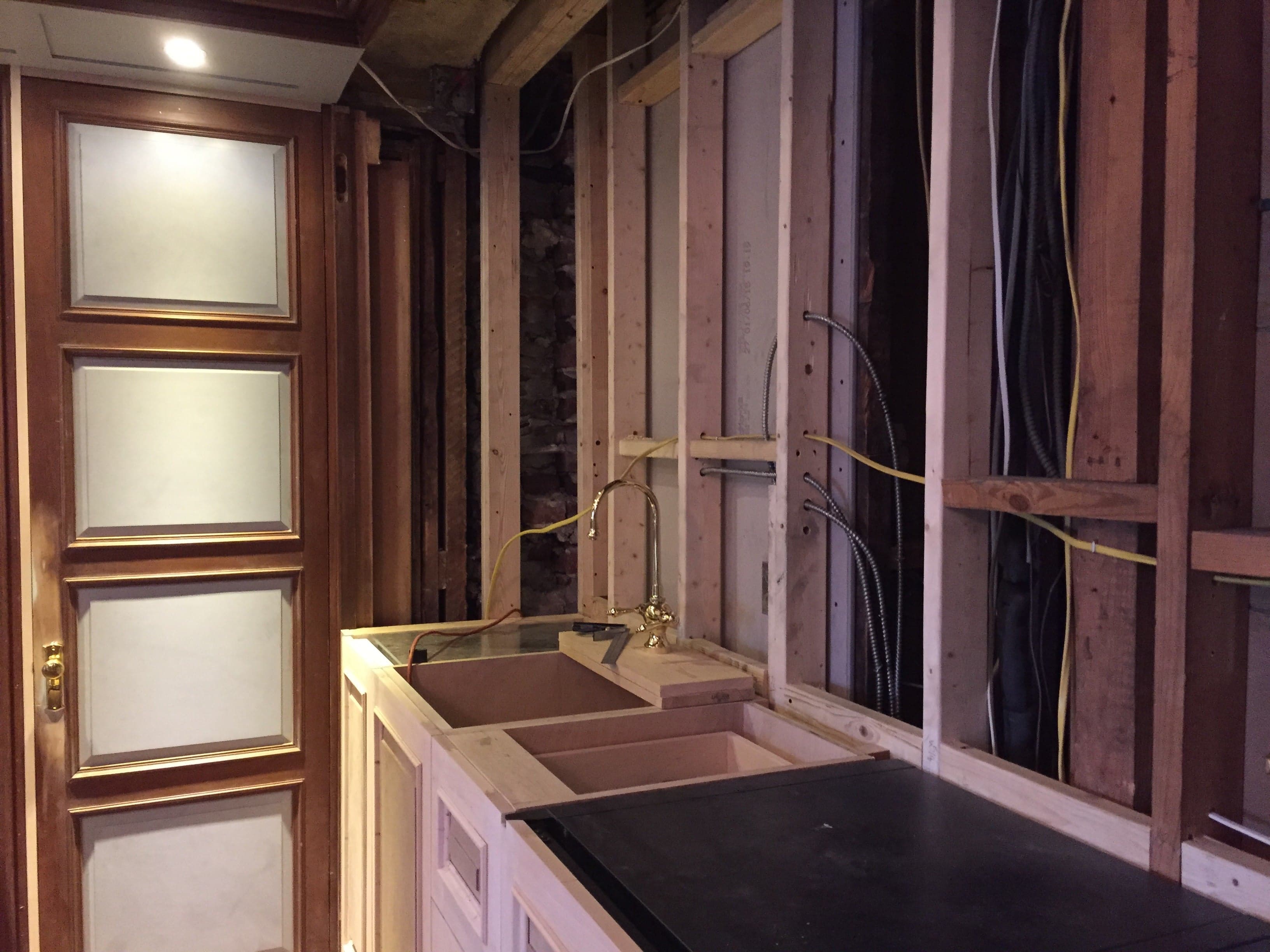
By March 2015, the custom cabinetry was already taking shape. The image shows the mockup of the wet bar sink and faucet, positioned for close-tolerance fitment verification before any final installation. Also visible: the new LED recessed lighting integrated into the space above. Every fixture location was planned in relationship to the cabinetry layout, the reflectivity of the finished surfaces, and the way the Limoges Blue lacquer would eventually interact with directed light. Lighting in a space like this is not an afterthought. It is part of the design from the first drawing.
---
Protecting What Already Exists
The recessed lighting plan was shaped, in part, by what could not be touched. The original wood paneling throughout the parlor presented its own set of constraints — some sections were salvageable, others needed replacement, and some simply could not be disturbed at all.

This closeup, taken in May 2015, shows the original wood paneling behind the carved stone mantle. The checking — surface cracks developed over a century of seasonal movement — was significant, but replacement was ruled out because the risk of damaging the mantle during panel removal was too great. The decision was made to repair in place. With considerable effort, that panel was brought to a flawless surface condition. The point here is relevant to the lighting work as well: every decision in a restoration of this age requires understanding what is at risk before anything is cut, drilled, or removed. The soffit approach to recessed lighting was chosen precisely because it kept all risk away from the original ceiling.
---
Prep Work and the Surface Before the Finish
Lighting reveals everything. A room with poor surface preparation will announce every flaw the moment the fixtures are switched on. That reality shaped how much time was spent on prep across every surface in this parlor.

The wall opposite the wet bar is shown here in pre-paint stage, with the removal of the old finish completed and new replacement panels installed. Sanding, patching, and panel-by-panel inspection preceded every coat. The small closet visible to the far right, already painted and masked for protection, gives a sense of how sequenced and methodical the process was. Nothing was finished until the surface behind it was ready.
---
The Room as It Stands

The completed parlor shows what proper integration looks like. The recessed shelf panels across both sides of the room, the restored paneling detail, the ornamental mantel — all of it reads as a coherent whole. The soffit ceiling with its recessed lighting does not call attention to itself. It illuminates.

The wet bar installation in Limoges Blue lacquer, the carved stone fireplace mantle, the custom framed mirror, the half-inch thick tempered glass floating shelves — this is a room that functions as a finished environment, not a collection of individual upgrades. The lighting made that possible without leaving a trace on anything the original builders left behind.
---
Modern LED technology integrated into a 100-year-old parlor without compromising the historic ceiling is not a marketing claim. It is a documented outcome, achieved through careful planning, purpose-built construction, and the kind of respect for original material that this category of work requires.