
Matching the Old to the New: Why Finished Elevation Is the Hardest Part of a Home Addition
There is a particular kind of difficulty that does not announce itself in a project budget or a permit drawing. It lives in the gap between what a structure looks like today and what it must look like when the work is done — seamless, settled, as though it was always there. In residential construction, few scopes expose that difficulty more honestly than building a new exterior enclosure onto an existing home. The Upper St. Clair residential elevator project is a precise example of what that challenge actually requires.

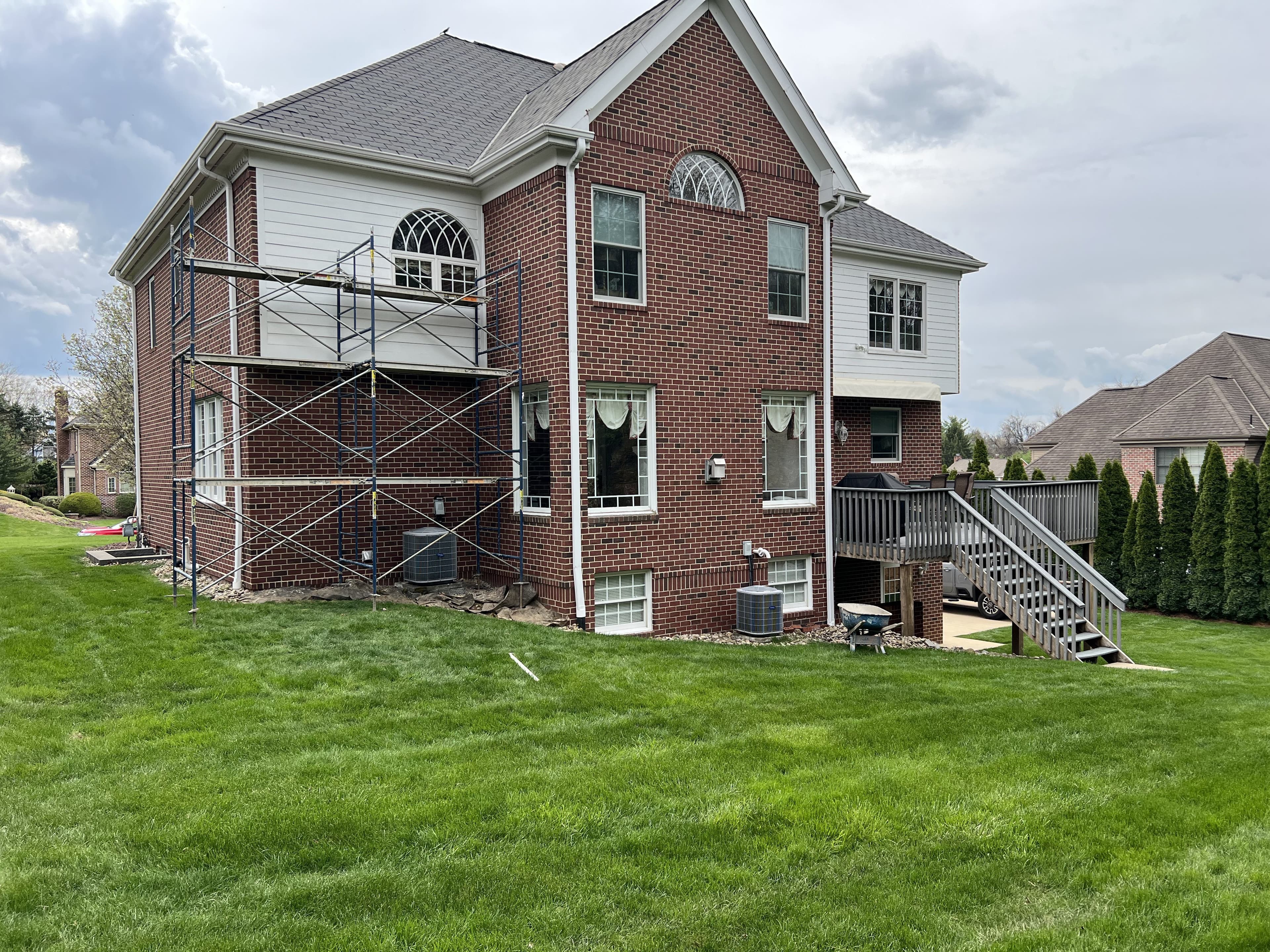
This is the rear corner of the home before a single shovel broke ground. The site was chosen deliberately. That corner placement puts the elevator doors in the least invasive positions relative to the interior floor plan — basement, first floor, second floor, each stop positioned to minimize disruption to the living spaces that already work. But the location also creates the central design problem: a brand-new exterior shaft enclosure must rise from an excavated foundation all the way to the roofline and tie into a structure that has years of weathering, established coursework, and a finished elevation that cannot be approximated. It must be matched exactly.

The scope sounds straightforward when you list it: excavate a basement addition, build an elevator-specification foundation, construct new exterior walls forming the enclosure, frame and pour a new roof, tie that roof into the existing. What that summary does not capture is the compounding tolerance problem layered into every phase. The finished elevation must align with the existing structure exactly — the roofline, the facade plane, the brick coursework, the trim lines. Simultaneously, the structural specifications inside that enclosure must meet or exceed the elevator manufacturer's strict requirements. Those two sets of constraints do not always cooperate, and the crew working between them has no room to split the difference.

Below grade is where the precision begins. Foundation formwork and rebar installation in the excavation pit establish the perimeter for the concrete pour. The structural reinforcement grid is laid across a 10-by-10-foot foundation cavity — a dimension driven by the elevator manufacturer's foundation requirements, not by what would be convenient to form and pour. Pittsburgh-area ground water is a given at these depths. It is not a surprise; it is a condition that gets managed. The makeshift sump basin and continuous pump shown in the center of this photo are exactly that — continuous. Water evacuation runs alongside every other task until the foundation is sealed and the work rises above grade.

After the pour, the vertical rebar transfers upward from the footing into the stem walls. That continuity is not decorative. It is what connects the foundation to everything that will be built on top of it and ensures the shaft meets the load requirements the elevator system demands. Two details in this photo carry significant weight. First, the perimeter concrete elevation is set to match the existing basement floor — not approximately, but exactly. Second, there is a 9-inch recessed square cast directly into the foundation. That recess is required so the elevator car floor sits flush with the basement floor at full stop. Miss that dimension and the installation fails its most basic functional test before the car is ever set.

Block courses build the stem walls to the required height, establishing the general wall surfaces of the new enclosure. Once that height is reached, the top of the foundation wall is formed with special shapes — stepped brick ledges and sill plate seats — that are specific to what comes next. The blocks and the poured concrete, including grouted block cells, are finished in one monolithic pour. This is the moment where the foundation transitions from a structural requirement into a building platform, and the dimensions set here will govern how the exterior walls rise and whether the finished facade reaches the existing structure at the right elevation. There is no adjustment available later. The numbers either work or they do not.
The roof tie-in represents the final test of every decision made below it. When new framing meets existing rafters, the finished roofline must read as continuous. No step, no shadow line, no reveal that tells a visitor something was added. Achieving that requires working backward from the existing conditions — measuring the established pitch, the ridge height, the fascia elevation — and building the new enclosure to meet those numbers rather than hoping the framing will work itself out at the top. LVL engineered beams carry the structural loads where conventional lumber cannot provide the span or the depth without compromising the dimensional targets. Simpson structural connectors tie the new framing to the existing at every critical junction. These are not upgrades chosen for appearances. They are the materials that make precision buildable.

The interior of the elevator car is where the project's ambition becomes visible to the homeowner every day. A fully ADA-compliant installation with commercial-quality performance and a neutral finish that integrates with any decor. What is worth noting here, beyond the finish quality, is the trim around the elevator doors. It matches the original standard doors throughout the home — not as an afterthought, but as a design commitment that extends the same logic from the exterior facade to the interior threshold. The new does not announce itself. It joins what was already there.
That is the honest measure of a finished elevation, inside or out. Not whether the addition is visible, but whether it reads as something that belongs. In Upper St. Clair, from the excavation pit to the roofline to the door trim, that standard was the only one on the table.
View the complete Upper St Clair Residential Elevator project