
Tudor Charm Meets Modern Living: Updating a Historic Parlor Without Erasing Its Story
Every historic home eventually presents the same question: how much do you keep, and how much do you change? It sounds philosophical until you're standing in front of a century-old parlor with surface-cracked wood panels behind a hand-carved stone mantle, a wet bar footprint that refuses to conform to standard cabinet dimensions, and walls that need to look brand new while still feeling like they always belonged there. That's not a design problem. That's a craftsmanship problem — and it's exactly the kind of work this crew lives for.
The Shadyside Parlor Restoration didn't begin with a vision board. It began with an honest assessment of what the room was, what it needed to become, and where those two things could meet without either one compromising the other.
---
Where You Don't Touch the Stone

The original wood paneling behind the carved stone fireplace mantle told the whole story in miniature. Surface checking — the fine cracks that appear in bare wood as it cycles through decades of seasonal movement — had worked its way across the panel face. The instinct might be to replace it. The correct answer was to repair it.
Removing that panel meant accepting real risk of damage to the mantle, and no material value of a replacement panel justifies that trade. So instead, the panel stayed in place and the repair work began. The result, after considerable effort and meticulous surface restoration, was a finished panel that showed no evidence of its history. Flawless. That's not hyperbole — that's the standard this project required.
That single decision captures the philosophy of the entire restoration. The original material has value beyond its function. When it can be saved, it gets saved.
---
When Standard Solutions Don't Fit

The wet bar cabinet installation presented a completely different category of problem. The install area was irregular — not something a standard cabinet run could accommodate. So the cabinets were hand built to fit the specific geometry of the space.
What made this installation particularly demanding wasn't just the custom sizing. Standard cabinets mount directly to the floor. This site required a raised platform, and that platform couldn't look like an afterthought bolted beneath something pulled from a catalog. It needed to appear as though the platform and the cabinetry above it had always been a single intention. All of the latest cabinet hardware — Blum mechanisms throughout — was incorporated into the units, giving the finished installation the quiet, precise operation that belongs in a room of this quality.
That's the balance the whole project kept returning to: contemporary function delivered through workmanship that respects what was already there.
---
The Work Nobody Photographs


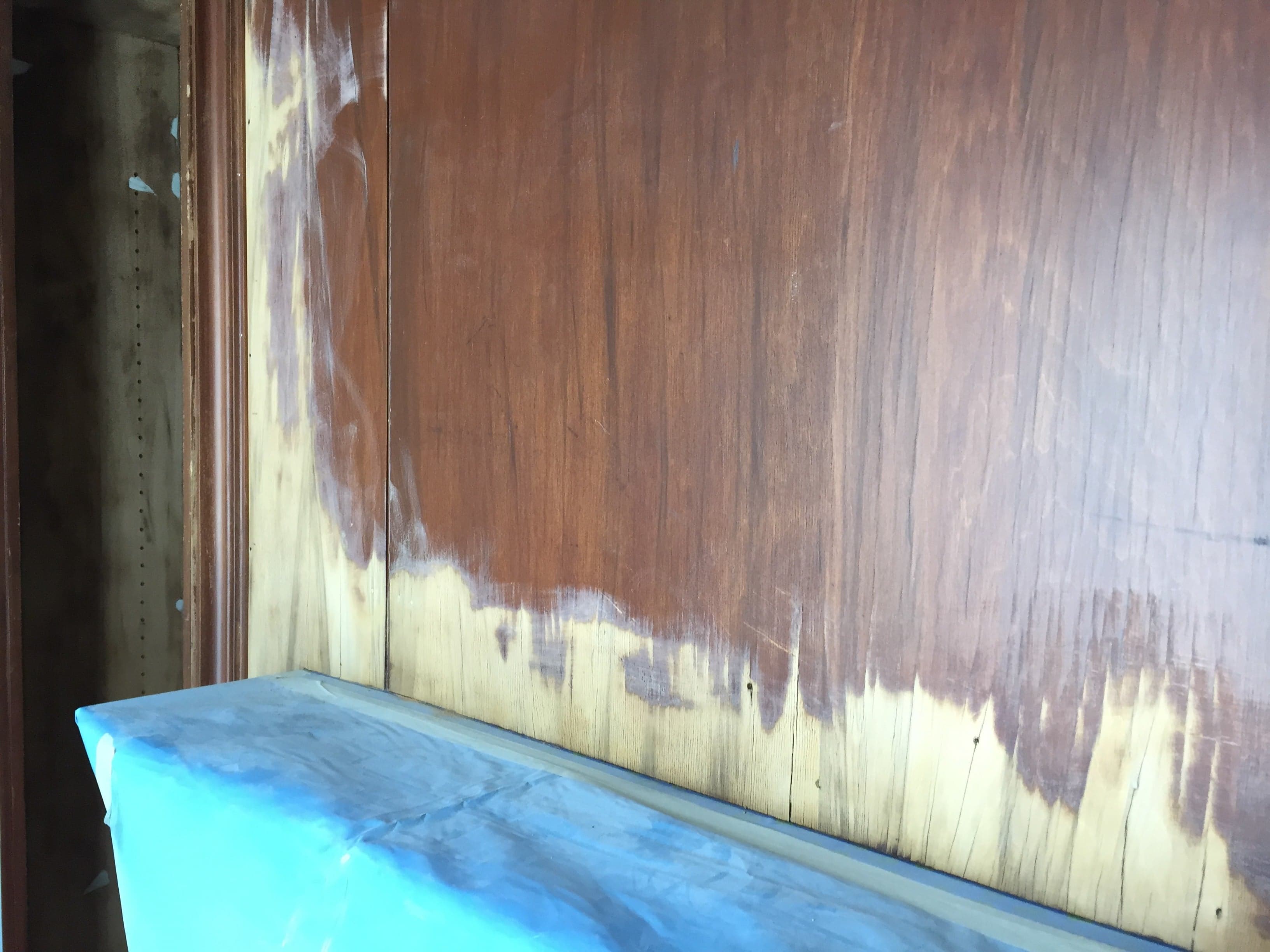
Before any finish goes on, there's a stage that separates serious restoration work from surface-level renovation. The wall opposite the wet bar shows it clearly — old finish stripped back, replacement panels installed, everything in pre-paint stage and ready for what comes next.
The replacement raised panels were fabricated from high-density fiberboard, which earns its place in this application for two reasons: dimensional stability and machinability. HDF doesn't move the way solid wood does, which matters when you're matching profiles and details to panels that were installed when this house was built. It machines cleanly, which matters when the carved detail in the original work sets the standard for everything new going in beside it.
Looking at the wall mid-process — the light grey HDF panels beside the dark reddish original finished material beside the lighter stripped original wood — you're seeing the full restoration timeline compressed into a single frame. Three states of the same wall. The preparation behind a finish that will eventually look like it was always there.
---
What Limoges Blue Does to a Room


The final lacquer application in Limoges Blue is where the cumulative effect of every prior decision becomes visible. The recessed shelf panels across both sides of the room, the restored paneling detail throughout the space, the fireplace surround and ornamental mantle — all of it lands differently once the finish is on and every individual component is reading as part of a unified whole.
The wet bar tells its own version of the story. The finished cabinetry, the back wall, the half-inch thick tempered glass floating shelves, the custom framed mirror — it's contemporary in its function and completely at home in a Tudor parlor. That's not a contradiction. That's what the project was always trying to achieve.
The carved stone mantle hasn't moved. The original paneling detail is intact. The room can now hold a gathering, serve drinks, and display the things that matter to the people who live there — without any of it feeling like a compromise of what the house actually is.
---
The Shadyside Parlor Restoration is a case study in what it means to work with a historic space instead of against it. The challenge facing any homeowner in a home like this — update for contemporary life without erasing the architectural character that makes the place worth preserving — doesn't have a shortcut. It has a process. It has material knowledge. It has the willingness to repair a panel behind a stone mantle when replacement would have been faster and easier.
This room still belongs to its house. It just works harder now.