
November 2020

This is what we're looking at before we start building: shallow crawlspace condition, existing kitchen load paths, and the actual framing reality that determines whether we're adding square footage the right way or the expensive way. Demo doesn't happen until we know what we're working with.
Nov 16
When an existing addition needs to come off, we don't guess. Full scope identification before first bucket swing—no surprises when the walls come down. This is how you protect the original structure underneath.
Nov 17
When addition removal meets structural reality. This pre-1950 brick home demanded careful demolition sequencing to preserve the original facade and prepare for dormer restoration. The kind of work most contractors avoid—exactly what we're built for.
Nov 19
When you open up an old Pittsburgh home, you need equipment that moves efficiently and operators who know what to look for. This Takeuchi track loader is clearing and grading the foundation exposure phase—where we get our first real look at what's been hidden in the walls for decades.
Nov 20
Foundation work on pre-1950 Pittsburgh homes demands precision. We remove what needs to go—concrete, deteriorated material, hidden surprises—without compromising the structure that stays. This is where scope discovery happens.
Nov 23
Site preparation is where the real diagnosis begins. Before we pour, we excavate—carefully, precisely, and with the right equipment for tight residential spaces. This is where hidden conditions reveal themselves.
Nov 25December 2020

Not all Pittsburgh sites are straightforward. Rocky conditions and tight access require the right equipment and experience to execute safely—and on budget. This is the kind of work we move through without panic or surprises.
Dec 4
Site preparation done right. Heavy equipment, careful sequencing, and experienced operation—the foundation work that prevents surprises later. This is what proper site diagnosis and execution looks like before the real work begins.
Dec 8Sheepsfoot remote controlled Trench Roller. foundation at excavation depth, original 1800's foundation visible in the background. Engineered compaction to subgrade soil density spec
Dec 9
Deep foundation work on a Pittsburgh residential addition. Every layer matters — we start with complete geotechnical understanding before the first pour. This is where the hidden complexity gets solved.
Dec 10
This is what diagnostic work looks like before the walls come down. Proper preparation—careful existing facade removal, structural assessment, and protective sequencing—is the difference between a project that stays on schedule and one that surprises you mid-demo. Winter doesn't stop us.
Dec 15
Not all foundation problems show up in a home inspection. Our crew gets underneath to see what's really there — and what needs to be done to keep these old structures standing another 100 years.
Dec 16
Foundation assessment is where the real story starts. This excavation reveals what's holding up your house—and what needs to change before we add four stories on top of it. This is the work most contractors skip. We don't.
Dec 16
When other contractors see a boarded facade and hidden systems, they walk. We see opportunity. This pre-1950 Pittsburgh home is mid-scope on a four-story addition — original brick is being carefully salvaged and will be reinstalled to blend new construction with the old. This is the work that separates a crew that knows these houses from one that's guessing.
Dec 17
Winter construction doesn't stop progress. Temporary framing secured and ready for the next phase while the existing brick holds its character. This is what happens when a crew knows how to work through Pittsburgh's toughest seasons.
Dec 19
Standing water and soil conditions don't scare us — they're exactly what we solve before it becomes a six-figure problem. This is the kind of site that separates contractors who know old Pittsburgh from the ones who'll call you three months in with bad news.
Dec 19
Manual foundation excavation, underpinning, extreme conditions, mortared stone rubble foundation from 1800's. detailed manual excavation required for precision. layered rocky soil shown.
Dec 21
Proper foundation work isn't glamorous, but it's everything. Our in-house crew executes every pour to current code—rebar placement, drainage integration, and keyway formation done right the first time.
Dec 29January 2021

Proper foundation forming isn't something you rush or improvise. Every detail—bracing, weather protection, material staging—affects the structural integrity that everything else sits on. This is the kind of foundational work that separates contractors who understand load paths from those who cut corners.
Jan 6
Meticulous tie-rod placement in foundation formwork systems is non-negotiable. The hydrostatic pressure from a concrete pour demands precision sequencing and expert crew coordination — the kind of detail that separates solid foundations from expensive failures.
Jan 7
Before the real work starts, the site is locked down. Temporary enclosure, staged materials, and proper foundation protection—these are the unglamorous prep details that prevent costly surprises and keep the project on track through Pittsburgh winters.
Jan 7
This is what diagnosis looks like before demo starts. Late-1800s foundations hide complexity—our crew investigates every cavity, every load path, every code requirement before we touch a beam. It's the work most contractors skip that saves you from surprises.
Jan 11
Foundation work doesn't wait for spring. Protective sheeting and proper drainage planning keep Pittsburgh's unpredictable weather from derailing your project timeline—and your budget.
Jan 14
This is what we're looking at before the real work starts. Pre-1950 Pittsburgh foundations tell stories—and they demand respect. Proper assessment of subsurface conditions, load paths, and existing structural systems is non-negotiable before demo.
Jan 14
Stripped formwork reveals the real foundation work: properly installed tie rods, structural bracing, and weather protection that keeps the next phase on schedule. This is the kind of detail most crews skip — we don't.
Jan 14
This is what happens when you actually know what's underneath. Exposing the original foundation to understand the structural reality before making a single decision—the diagnostic work that saves money and prevents surprises later.
Jan 14
Proper foundation prep separates work that lasts from work that fails. This is the kind of detail most contractors skip—but it's exactly what Pittsburgh's older homes need when they're rebuilt right.
Jan 25
Foundation work on a historic Pittsburgh addition — insulation board set, compacted base prepped for framing, and temporary weather protection keeping the schedule on track regardless of season. This is where precision matters before the first load-bearing piece goes in.
Jan 25
Foamular 250 rigid foam insulation installation over foundation with protective black drainage membrane, R-10 rated panels positioned for moisture resistance and thermal performance. the process guarantees that moistures stays out of the new basement space.
Jan 27
basement construction, concrete walls, temporary wooden stairs, fiberglass ladders, paint buckets, exposed engineered ceiling joists, work-in-progress interior build-out, drainage PVC piping showing below the basement slab, 2 below grades sumps in the background
Jan 28
Foundation drainage system installation, gravel base preparation with white PVC perimeter drain lines, black sump basins positioned for water management.
Jan 28February 2021

Foundation work done right — vapor barrier and geo-textile laid before concrete pour. The kind of below-grade detail most contractors skip over. We don't.
Feb 2
Layered foundation preparation, geo-textile, vapor barrier, Creatherm radiant heat foam board installation, concrete subfloor in progress. Stego Wrap vapor barrier is the key to sub grade ground water containment.
Feb 2
Proper vapor barrier sequencing is where foundation longevity starts. We treat below-grade moisture management with the same precision we apply to every system — because the stuff you don't see is exactly what keeps a Pittsburgh home standing another hundred years.
Feb 3
Radiant floor heating requires precision installation and proper substrate preparation. Our in-house crew knows the sequencing that protects your investment and ensures even heat distribution for decades.
Feb 3
Before the 4-inch slab goes down, every loop gets inspected and tested. Rehau tubing, Creatherm insulation, dual evacuation sumps, and full expansion joints—built to code and designed to last.
Feb 3
Radiant floor heating system installation, PEX tubing grid installed in the Creatherm dimple method. thermal insulation board with integral thermal breaks, concrete subfloor preparation, in-situ installation in progress, 1/2" rebar grid suspended on 2" concrete chairs
Feb 3
Early-stage basement addition with mono-poured concrete walls and radiant heat PEX distribution rough-in. This is where the complexity lives—proper sequencing, manifold placement, and code-compliant installation before walls close. The kind of work most contractors skip or get wrong.
Feb 6
Pre-pour PEX coordination locked in. Floor penetrations set, tubing routed, and ready for inspection before the pour hardens. This is where the details matter—and where we don't skip steps.
Feb 6
Framed wall construction in-progress, second floor platform, winter conditions with bare deciduous trees in background, addition structure framing phase. 2x6 exterior wall framing
Feb 10
Winter doesn't stop structural work. Here's what second-floor platform framing looks like when you're connecting new space to an older Pittsburgh home—exposed cinder block, proper sequencing, and the technical precision that lets us build to code without losing the character of what's already there.
Feb 10
Exterior facade removal on a pre-1950 Pittsburgh brick home requires more than demo skills—it demands structural bracing, code-compliant temporary weather protection, and the discipline to work safely in winter conditions. This is the kind of work other contractors defer.
Feb 10
Winter framing demands precision and protection. Our crew secures every joist hanger to code—no shortcuts, no surprises. This is how structural work stays structural.
Feb 18March 2021

Energy-code compliant roof framing in progress. 14" I-joist rafters with diagonal bracing deliver R-49 insulation rating while maintaining structural integrity. Engineered lumber and Zip sheathing create a weather-tight envelope before weatherproofing.
Mar 7
Modern engineered framing built to current code without compromising the integrity of the addition. This is the kind of structural work that separates confident execution from guess-and-check.
Mar 9
Ridge beam connection work on a roofing addition. This is where the engineering happens — load bearing sequencing, code-compliant fastening, and structural integrity that lasts decades. Precision framing built to meet code without compromise.
Mar 10
This is what proper old-house execution looks like: systematic slate removal with full fall protection on a steep pitch, before integration with the addition structure. Not every crew will take on this kind of work—we do.
Mar 10
Structural integrity starts before the walls go up. This ridge beam assembly and engineered rafter system is engineered, sequenced, and connected to current code — the kind of foundation that keeps a Pittsburgh addition standing solid for generations. This is how we build additions that belong.
Mar 13
Addition framing at mid-stage: engineered lumber floor joists set, temporary bracing secured, exterior Zip sheathing installed, and mechanical rough-in staged for next phases. The kind of controlled sequencing that prevents surprises during closure.
Mar 13
Dormer and main roof framing on an addition addition — engineered lumber rafters secured to code-compliant bracing, staged for weather closure. This is the sequencing most contractors skip: proper load bearing, temporary safety infrastructure, and staged weatherproofing prep before the envelope closes.
Mar 16
Proper sequencing and load-bearing installation matters. Every joist, every connector, every brace positioned to code—this is the framing work most crews rush. We don't.
Mar 16
This is what code-compliant roofing installation looks like on a steep pitch: engineered lumber sheathed correctly, fasteners set properly, and weatherproofing membranes installed before any exposure. The details matter when the goal is a roof that lasts.
Mar 17
Old Pittsburgh homes don't need to stay cold. We overlaid this original roof with R-10 foam board and new plywood sheathing—jumping the system from R-31 to modern performance standards without touching the character of the house. This is how you make an old home energy-efficient the right way.
Mar 17April 2021

This is what proper sequencing looks like. Zip sheathing down, structural bracing in place, and every access point engineered for safety before the real work begins. The difference between a project that stays on schedule and one that doesn't.
Apr 5
Engineered sheathing staged and ready. Zip System insulated panels—half-inch OSB laminated with one-inch foam—deliver both structural integrity and thermal efficiency on complex foundation closures. This is the detail work that separates built-to-last from built-to-flip.
Apr 5May 2021

Proper sequencing starts before the roof goes on. Every joist, every blocking member, every connection engineered and installed to code — the foundation for a patio that will outlast the house. This is what invisible quality looks like.
May 19
Upper-floor structural assembly built to code with engineered lumber, Zip System sheathing, and permanent bracing that stands up to Pittsburgh conditions. This is what happens when framing isn't rushed.
May 19June 2021

Second-floor addition taking shape. Zip System panels and character-appropriate salvaged brick installed to current code—the kind of detail work that disappears into the finished wall but anchors the whole project. This is what envelope closure looks like when it's done right.
Jun 29July 2021

This 1930s half-timbered brick residence is exactly the kind of house most contractors won't touch during addition work. The challenge: build addition, preserve character. We started with a hard look at what's holding up that cantilevered upper wall and those exposed beam ends before we broke ground.
Jul 9August 2021

Zip System sheathing and integrated weather barrier going up on the second-floor exterior. This is where the difference between someone who knows Pittsburgh's older homes and someone who doesn't becomes very visible — proper envelope closure now means no hidden moisture problems later.
Aug 13
This is what proper staging looks like during complex exterior framing. Zip system panels, half-timber integration, and structural sequencing done in the right order—the kind of detail most crews rush or ignore on older Pittsburgh homes.
Aug 16
Character-appropriate detailing matters. This cream-trimmed gable pediment—original ornamental carving, hand-matched molding, properly sized multi-pane window—gets rebuilt the way it was meant to be. That's how an addition stays honest.
Aug 19
Exterior wall framing and sheathing sequencing on a complex rear patio renovation. Marvin windows set into reclaimed brick with standing seam metal roofing and tongue-and-groove ceiling — the kind of detail work that separates execution from approximation.
Aug 25
This four-story addition demanded precision sequencing across structural steel, load-bearing brick columns, and contemporary fenestration—the kind of complexity most contractors avoid. Built to current code without cutting character.
Aug 26March 2022

Third-floor dormer reaching completion. New slate roof with copper trim, half-timber upper walls with angled brick infill, and Marvin Ultimate windows installed throughout—character-appropriate renovation built to current code.
Mar 24April 2022

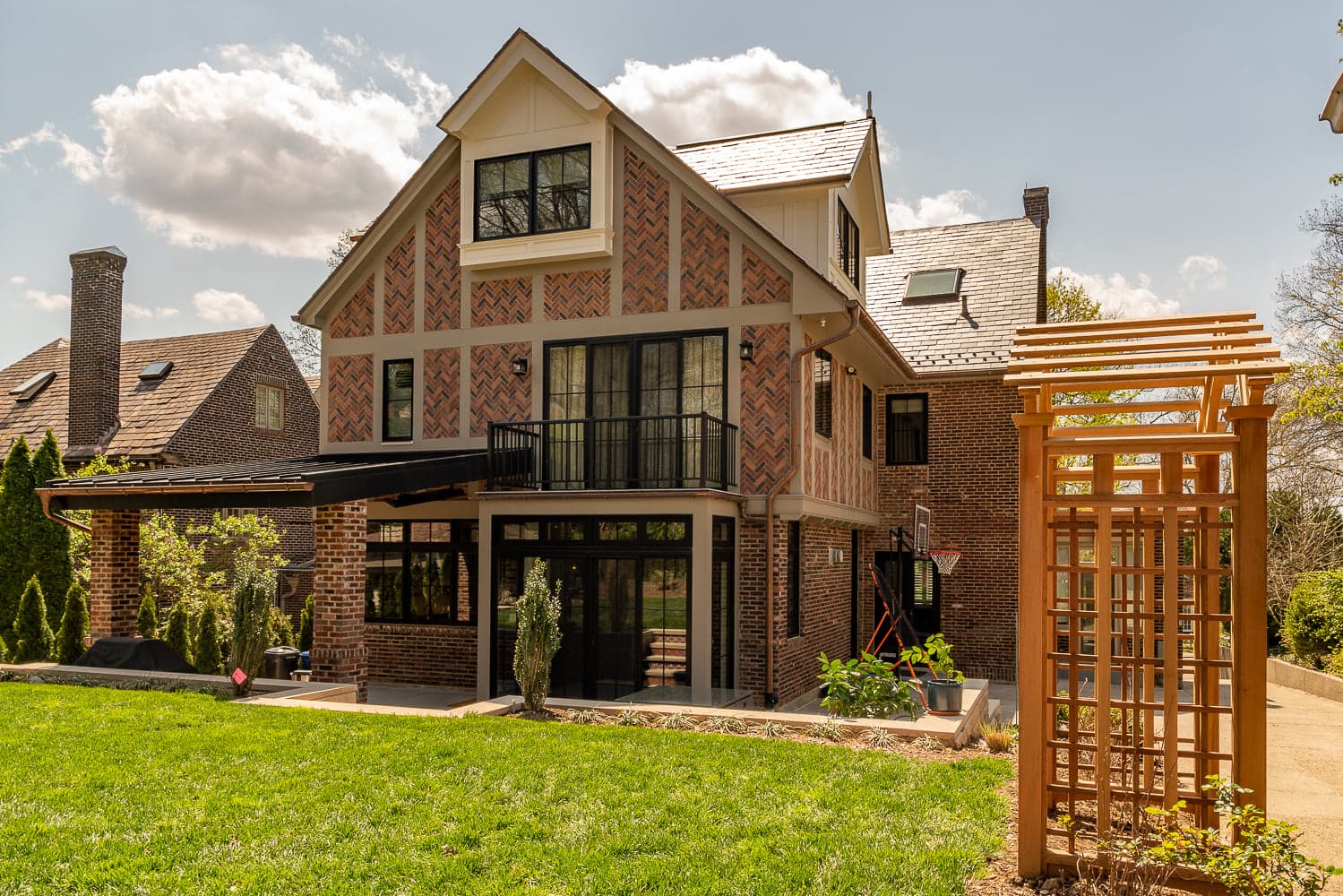
Completed rear patio exterior showing brick columns supporting standing seam metal canopy structure with German copper guttering, tongue and groove wooden ceiling with ceiling fan and installed Infratech infrared heaters, large multi-pane Marvin Ultimate windows and black-framed glass doors providing transition to interior spaces, porcelain patio flooring, brick was reclaimed from earlier brick facade removal integrated into addition design, spring conditions with landscape preparation visible.
Apr 23
This isn't preservation theater — it's a complete addition that reads like it belongs. Half-timber detailing with authentic herringbone brick infill, built to current code without losing the character. The kind of work other crews avoid.
Apr 23
Completed rear patio and lower level entrance showing brick columns supporting standing seam metal canopy with tongue and groove soffit detail, black-framed glass door providing transition to interior spaces, copper gutter system, Infratech infrared heaters, porcelain patio flooring, reclaimed brick integrated into addition exterior walls, metal railing on upper level balcony visible above, spring conditions with established landscape and evergreen plantings, post-construction phase showing finished exterior systems and material integration.
Apr 23
Post-construction detail showing how reclaimed brick, character-appropriate window framing, and traditional masonry patterns integrate seamlessly into an older Pittsburgh home. This is what happens when material selection and installation sequencing matter.
Apr 23