
Squirrel Hill Addition: Building Up from a Shallow Crawlspace
A four-story addition doesn't begin with steel and concrete. It begins with an honest look at what's already there — and at 1319 Squirrel Hill Ave, what was there presented a clear set of challenges from the start.

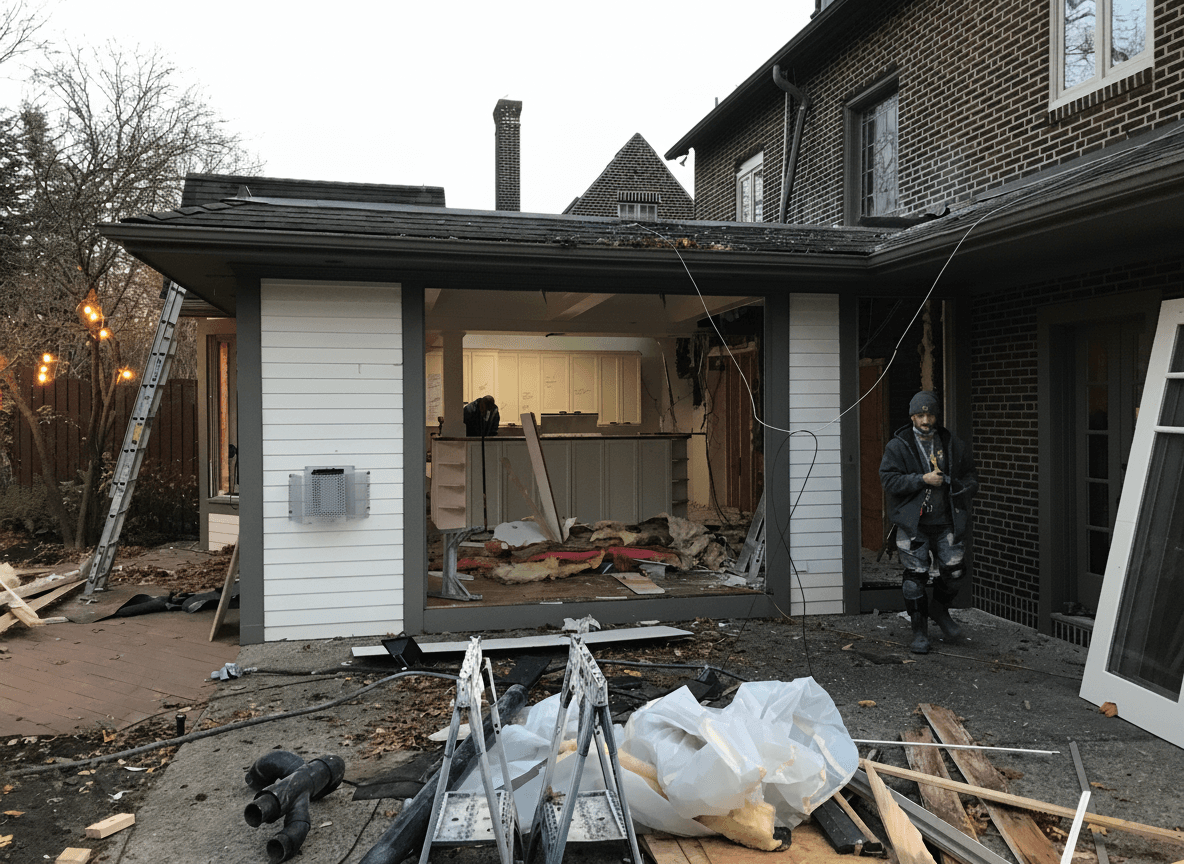
This November 2020 photo captures the existing conditions before a single shovel hit the ground: a small single-story addition tacked onto the original home, a previous kitchen, and a shallow unconditioned crawlspace underneath. The original brick structure is intact, but the footprint tells the story of a house that had been patched and extended over decades without a coherent plan. B2 Construction's job was to replace that modest addition with something structurally sound and purpose-built — four stories, designed to last.
Breaking Ground in Winter
Pittsburgh winters don't pause for construction schedules, and the Squirrel Hill Addition was no exception. By late November 2020, the team had mobilized a Bobcat E55 compact excavator to begin clearing the residential foundation area. Soil removal and grading work pushed forward despite the season, with the existing brick facade standing in the background as a constant reference point for the scale of work ahead.

Working in winter conditions requires a different kind of discipline. Frozen ground, shortened daylight, and the ever-present risk of weather delays demand that every productive hour count. The excavation here wasn't simply digging a hole — it was preparing a foundation area capable of carrying a structure three stories taller than what it was replacing.
Removing the Old Facade
Mid-December brought a critical step: removing the existing brick facade from the exterior wall where the addition would connect. This is often where residential addition projects get complicated. The original masonry isn't just decorative; it's structural. Pulling it back requires scaffolding, careful sequencing, and a clear plan for protecting the interior of the occupied structure during the process.

The December 15 photo shows metal scaffolding in place, openings boarded and wrapped in temporary protective sheeting, and the beginnings of structural remediation visible on the wall surface. The brick removal exposed what the facade had been hiding for decades — original construction details, previous patches, and the kind of masonry history that's common in Pittsburgh's older residential stock. Getting this right meant the new addition could tie into the existing structure properly, without compromise.
Foundation Work: Cold, Wet, and Essential
By December 19, the foundation pit was open — and standing water had collected at the base. This is a familiar situation on winter excavation projects in the region, and it's one that demands immediate attention. A concrete foundation for a four-story addition requires dry, properly prepared conditions. The temporary wooden site enclosure visible in this photo wasn't just a weather precaution; it was an active part of keeping the work moving.

The enclosure held through the coldest stretch of the project. A night photo from January 7, 2021 shows the site buttoned up tightly — foundation work in progress below grade, the exterior HVAC unit of the adjacent structure still operating, and the temporary enclosure doing its job in the dark.

Underpinning and below-grade construction in extreme cold requires careful attention to concrete curing temperatures and moisture control. What looks like a quiet night photo is actually evidence of active management — keeping the foundation environment stable enough to proceed correctly.
Vapor Barrier Installation
February 3, 2021 marks a turning point in the below-grade work. With the foundation excavation complete and concrete preparation underway, the team installed Stego Wrap vapor barriers — a critical layer between the earth and the concrete slab.

Stego Wrap is a reinforced polyolefin barrier rated for below-slab applications, and its installation here reflects a detail-oriented approach to the foundation assembly. Moisture migration through a concrete slab is a long-term problem that reveals itself slowly — condensation, efflorescence, degraded floor systems. Getting the vapor barrier right at this stage protects everything built above it for the life of the structure.
Materials Built for the Work
Throughout the project, B2 Construction specified materials matched to the demands of the application. Creatherm and Owens Corning Foamular provided thermal insulation continuity in the foundation assembly. Dayton Superior forming and accessories supported the concrete work. Takechi equipment contributed to the excavation and site preparation phase alongside the Bobcat E55.
None of these are decorative choices. They're specified because they perform — in cold weather, in wet conditions, and in a building that now needs to serve its occupants for decades.
From Crawlspace to Four Stories
The Squirrel Hill Addition ran from November 2020 through October 2021 — nearly a full year from initial excavation to completion. What began as a shallow, unconditioned crawlspace beneath a modest single-story addition became the foundation for a four-story structure integrated into an original Pittsburgh brick home.
The project required excavation in winter, facade removal and structural remediation, precise below-grade vapor and thermal detailing, and the kind of sequenced coordination that residential addition work demands when the existing structure is occupied and the site is tight.
The result is a building that earns its place on Squirrel Hill Ave — not through appearance alone, but through the quality of work that sits beneath the surface.